


If a tooth looks longer while you are wearing Invisalign, it is reasonable to ask whether treatment is involved. A change noticed during treatment does not, by itself, establish that the aligner caused it. The gum margin, oral health, cleaning habits and tooth position all need professional assessment.

This guide is for Woodbridge-area aligner patients deciding what to report and how to prepare for a review. It focuses on gum changes during removable-tray treatment, including fit and daily care. It does not diagnose recession or tell you to pause, advance or otherwise change your prescribed treatment on your own.
What gum recession means
Gum recession describes a gum margin that has moved away from its previous position, exposing more of the tooth or root. You might notice a longer-looking tooth, a visible root area or sensitivity. Bleeding and swelling can accompany gum disease, but appearance or a symptom list cannot establish the cause.
The National Institute of Dental and Craniofacial Research lists receding gums among signs that deserve assessment and explains the importance of plaque control and professional care. Some changes are gradual, which is why the team may compare current findings with earlier records.
A selfie can help you describe when you noticed a change, but it does not replace an examination. Lighting, camera angle and tray reflections can also make a tooth appear different.
Separate the observation from the explanation
“Something changed after I started Invisalign” is useful information. “Invisalign must have caused it” is a conclusion that needs investigation. Tell the clinician the timing without assuming the answer.
The assessment may consider existing gum disease, plaque accumulation, brushing technique, the supporting tissues and planned tooth movement. A tray edge that feels irritating is another issue to report. Several factors can be relevant at once, and a clinician may recommend coordination with your dentist or a periodontal specialist.
Do not assume that clear aligners either prevent recession or inevitably cause it. Suitability and monitoring depend on the individual mouth and the plan.
Bring useful information to the review
| What you noticed | Detail to record | Why it helps the discussion |
|---|---|---|
| A longer-looking tooth | Which tooth and when you first noticed it | Gives the team a location and timeline to assess |
| Sensitivity | Triggers, duration and whether it is changing | Helps distinguish the concern from a general appearance question |
| Bleeding or swelling | How often it happens and whether cleaning is difficult | Supports review of gum health and technique |
| Tray irritation | The edge or area involved and current tray number | Helps the team assess appliance fit and contact |
| A changed routine | Missed cleaning, a new tool or recent dental work | Provides context without assigning blame |
| Previous gum concerns | Earlier diagnosis or relevant treatment | Helps coordinate care and compare records |
How trays fit into the cleaning routine
Removable aligners let you access the teeth without brackets in the way. That access is useful only when the cleaning routine is effective. Remove trays as instructed, clean the teeth and use the recommended method between teeth. Clean the appliance separately according to its care instructions.
Avoid trapping sugary drinks or food residue beneath trays. The general Invisalign wear recommendation is 20–22 hours daily, but your clinician provides the actual schedule. If cleaning and wear feel difficult to reconcile, ask for help planning the routine rather than skipping either responsibility.
Do not scrub harder to try to reverse a gum change. Ask the dentist or orthodontic team to review your brush, pressure and technique. Abrasive powders and household whitening remedies are not a treatment for recession.
Five steps when you notice a change
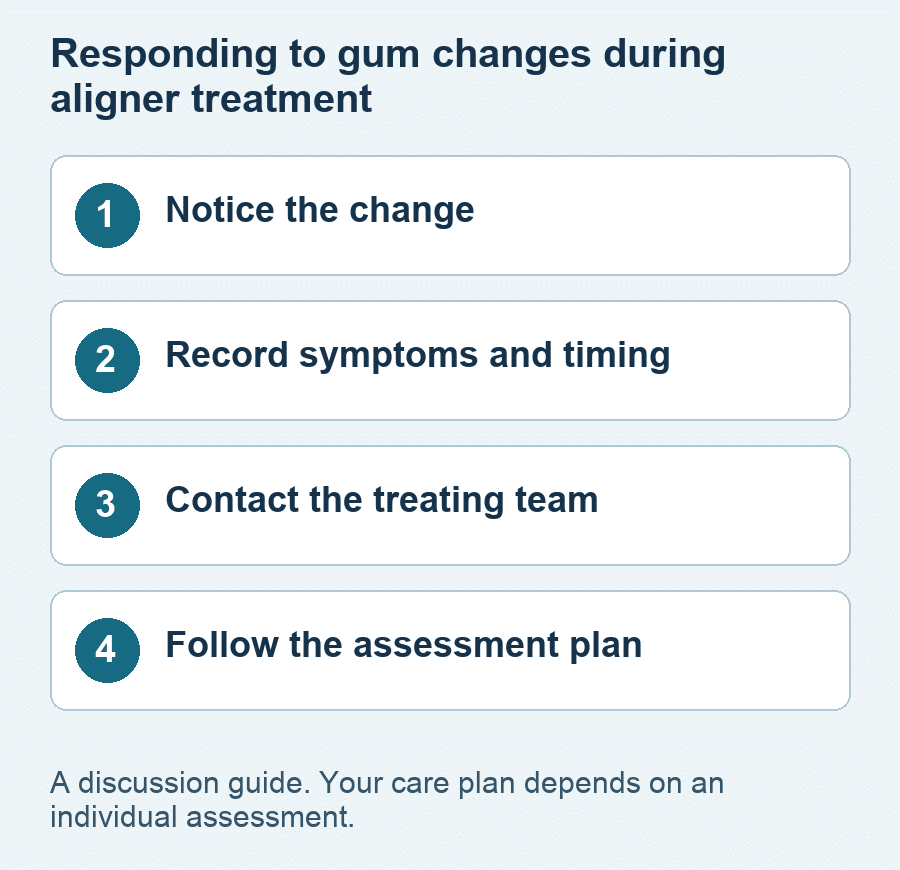
- Identify the area. Note the tooth or side and what looks or feels different.
- Record the timing. Include tray number, relevant symptoms and recent dental changes.
- Contact the treating team. Ask how soon they recommend assessment and what instructions apply meanwhile.
- Bring relevant history. Include earlier gum concerns, dental care and the tools you use for cleaning.
- Follow the coordinated plan. Confirm who will assess the gums, who manages tooth movement and when the findings will be reviewed.
Do not stop treatment, jump to another tray or trim the appliance based on a general article. A clinician should advise on the appropriate response to your actual findings.
What the review may lead to
The team may discuss cleaning support, dental or periodontal care, appliance fit or a review of the orthodontic plan. The next step depends on the diagnosis and severity. An article cannot promise that the gums will return to their previous position or that one product will resolve the problem.
Ask the clinician to explain what is being monitored and what change would prompt another visit. If more than one professional is involved, clarify responsibilities so the gum concern does not get lost between appointments.
Keep routine dental checkups during aligner treatment. Orthodontic reviews do not replace examinations or treatment for gum disease.
When to seek more urgent help
Severe pain, significant swelling, signs of spreading infection or symptoms after an injury should not wait for a routine cosmetic discussion. Breathing or swallowing difficulty needs urgent emergency assessment. Describe the symptoms directly when contacting a professional.
For a nonurgent but persistent change, arrange the advised review rather than waiting until treatment finishes. Earlier assessment can clarify the cause and the appropriate plan.
Smile Solutions’ Woodbridge-area information and Invisalign information can help you prepare appointment questions and confirm where care is provided.
Frequently asked questions
Does noticing recession during Invisalign prove the trays caused it?
No. Timing is relevant, but the clinician must assess gum health, cleaning, supporting tissues, tooth movement and other possible factors.
Should I stop wearing the trays immediately?
Contact the treating team for individual instructions. Do not make an unsupervised treatment change based on a general article.
Can stronger brushing make the gums grow back?
No. Do not scrub harder or use abrasive remedies. Ask for an assessment and a suitable cleaning technique.
Can gum recession be diagnosed from a photograph?
A photograph may help communication, but it does not replace examination and appropriate comparison with clinical records.
Do I need my regular dentist during aligner treatment?
Yes. Preventive care and assessment or treatment of gum disease continue alongside orthodontics.