


When you compare orthodontists, the words “specialist,” “licensed,” “board-certified” and “Invisalign provider” can appear together. They describe different things. Understanding those differences helps you verify a credential without treating one badge as a complete measure of care.

For patients choosing an orthodontist near Edison, a useful approach is to identify the actual clinician, check the relevant official source and ask about anything that does not match. This guide explains American Board of Orthodontics certification and a practical verification process. It does not assert a current certification status for a named doctor.
What ABO certification describes
The American Board of Orthodontics, or ABO, describes board certification as a voluntary process for orthodontists. Its patient information explains the credential and the board’s role. Certification is separate from a state dental license and from completion of specialty education.
An orthodontist can be a qualified specialist without holding this voluntary credential. Equally, a certification claim should be checked accurately when it is presented as part of choosing a clinician. Neither a positive online review nor a manufacturer’s designation substitutes for official credential information.
Ask which board is being referenced. The phrase “board-certified” should identify an actual certifying body rather than leave the reader to assume that every similar-sounding label means ABO certification.
Keep the credentials separate
| Information | What it concerns | How to approach verification |
|---|---|---|
| State dental license | Authorization to practise under the relevant state rules | Use the official state licensing source and match the clinician |
| Orthodontic specialty education | Training in the specialty | Review the clinician’s education and ask for clarification where needed |
| ABO certification | A separate voluntary board credential | Use ABO’s official information and orthodontist locator |
| Professional association membership | Membership in an organization | Do not treat membership alone as board certification |
| Manufacturer provider designation | A designation related to an appliance company’s programme | Ask what it measures; do not equate it with licensure or board certification |
| Reviews and awards | Patient experiences or a particular award’s criteria | Consider the context and verify clinical qualifications separately |
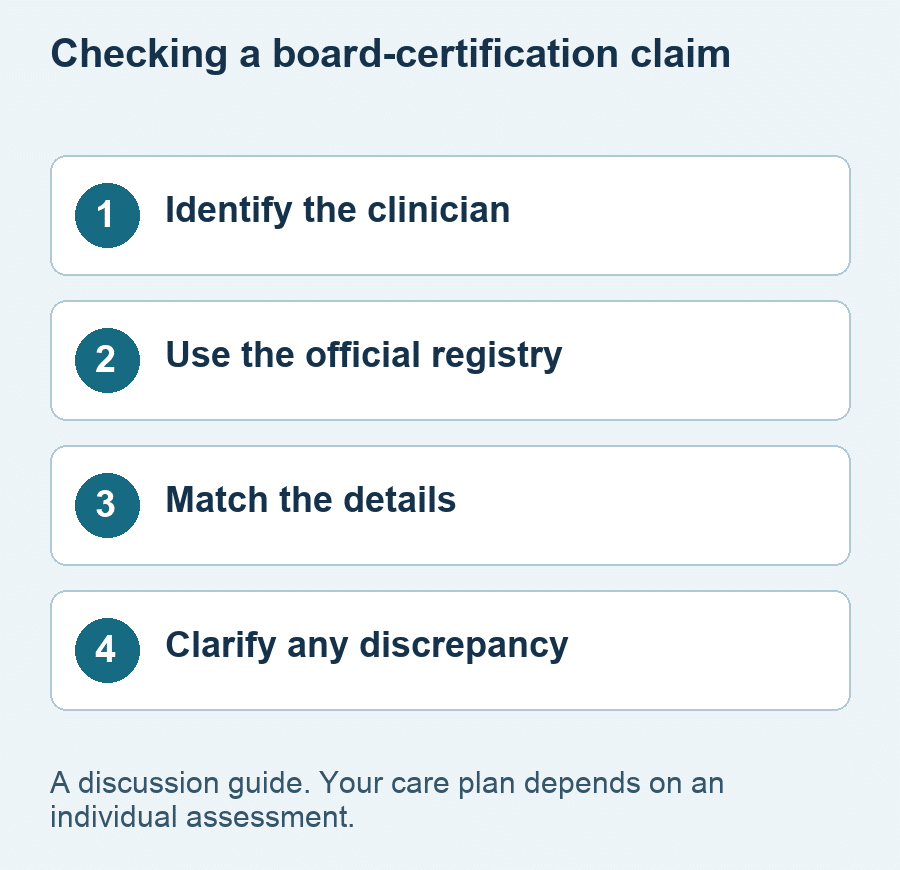
A five-step verification process
- Get the exact clinician’s name. Confirm who will diagnose the case and oversee treatment, including the spelling used professionally.
- Use the official ABO locator. Start from the board’s own website rather than relying only on a search-engine badge or directory summary.
- Compare identifying details. Check that the name and practice or location information fit the clinician you are researching.
- Ask about a discrepancy. A changed surname, location or an unclear result deserves clarification rather than an immediate assumption.
- Keep the credential in context. Also discuss the diagnosis, options, responsibilities, access, costs and follow-up.
Use the ABO orthodontist locator as the official starting point. Registry interfaces and available search details can change, so follow the board’s current instructions.
Why a missing or ambiguous search result needs care
A search can fail because the name or location entered differs from the listing. A website may also describe a credential without explaining its date or current status. Do not resolve uncertainty by guessing from a logo.
Ask the practice which certifying board it means and how to confirm the current claim. If necessary, use the board’s contact route for clarification. Avoid accusing a clinician of lacking qualifications based only on a failed informal search.
Similarly, a match to a common name is not enough. Confirm that it is the correct person. You are checking a clinician’s credential, not assigning the credential to every person working at the same practice.
Confirm who is responsible for your treatment
In a practice with more than one orthodontist, ask who will conduct the assessment, approve the treatment plan and review progress. A biography tells you about a clinician, but it does not automatically establish who will supervise a particular patient.
For Smile Solutions, the biographies for Dr. Chung and Dr. Epshteyn can help you identify the clinicians and prepare questions. Use official sources to verify a specific current credential claim.
Ask how care is coordinated if another clinician sees you at a review. Clear responsibility and communication matter across the full treatment course, not just the initial consultation.
Questions that still matter after checking a credential
Certification is one factor. A consultation should also help you understand the findings and whether the proposed plan fits your needs. Useful questions include:
- What alignment and bite problems are you proposing to treat?
- Which options are suitable, and what are their limitations?
- Who monitors progress and handles a problem between visits?
- What responsibilities will I have for wear, cleaning and appointments?
- What does the written fee include, including retainers and possible additional care?
- How is long-term retention managed?
The American Association of Orthodontists’ choosing-care guidance provides another framework for evaluating care. Verify the clinician and compare the actual plan rather than expecting a single label to answer every question.
Use a simple comparison record
Keep the clinician’s name, source checked, date and any question still unanswered beside your consultation notes. That makes it easier to compare practices without mixing one doctor’s qualifications with another practice’s fees or treatment recommendation.
If two plans differ, ask each clinician to explain the scope and trade-offs. A difference does not become clear simply by counting badges. Understanding the diagnosis and proposed care is part of making an informed choice.
Frequently asked questions
Is ABO certification the same as a dental license?
No. Licensure and voluntary board certification are separate facts and should be checked through their respective official sources.
Is every orthodontist board-certified?
No. ABO certification is voluntary. A specialist’s education, license and board certification are distinct considerations.
Does an Invisalign provider tier prove ABO certification?
No. A manufacturer designation is not an ABO credential. Ask what the designation measures and verify board certification separately.
What if the locator does not show a clear match?
Check the exact name and identifying details, then ask the practice or board for clarification. Do not infer the answer from an ambiguous search alone.
Is board certification the only factor in choosing care?
No. Also assess the diagnosis, suitable options, clinical responsibility, access, complete fees, communication and retention plan.