


Can braces close a gap from a missing tooth? Yes, they can, and sometimes that is the best answer. Sometimes it is not, and the better plan is to use braces to hold or reshape the space so a dentist can fill it with an implant or a bridge. Which is right depends on which tooth is missing, how much the neighbors have drifted, what the bite looks like, and the age of the patient. This guide from Smile Solutions Orthodontics, which treats Kenilworth families at its Union office, explains how orthodontists make that decision and what each route involves.
Key Takeaways
- Braces can close many gaps by moving neighboring teeth into the space, most predictably for a missing lower incisor or a missing premolar.
- For a missing molar or a missing upper front tooth, closing the gap often compromises the bite or the smile, and holding the space for an implant is usually better.
- Teeth next to a long standing gap tilt and drift; braces upright them whether the gap is closed or kept.
- In children and teenagers, an implant must wait until growth is finished, so braces often manage the space for years first.
- A scan and a bite analysis at the free consultation show which option suits your mouth.
What happens when a tooth is missing
A gap does not stay a gap. The teeth on either side tilt toward it, the tooth above or below it grows down or up into the space, and the bite shifts. The American Dental Association explains why a missing tooth is replaced or managed rather than ignored: the changes affect chewing, make cleaning harder, and can lead to further tooth loss. By the time many adults ask about closing a gap, the neighbors have drifted enough that some orthodontic movement is needed, whatever the final plan.
Closing the gap versus keeping it
| Situation | Close with braces? | Why |
|---|---|---|
| Missing lower front tooth (incisor) with crowding elsewhere | Often yes | The other lower incisors can be aligned into the space; the result is a natural-looking arch |
| Missing premolar, especially if extractions would have been needed anyway | Often yes | Closing the space mimics an extraction case; the bite is set up around it |
| Missing upper front tooth (central or lateral incisor) | Sometimes | The canine can be moved forward and reshaped to look like the lateral incisor, but symmetry and smile line are hard to keep; an implant is often better |
| Missing first molar | Rarely in adults | Moving a second molar forward a full tooth width takes years and risks tipping; an implant or bridge is usually better |
| Missing tooth in a child or teenager | Depends | An implant must wait for growth to finish, so braces either close the space or hold it with a retainer until then |
| Gap from a tooth lost long ago, neighbors badly tilted | Braces first either way | Teeth are uprighted before an implant or before closing the space |
The American Association of Orthodontists describes how braces move teeth, and the Cleveland Clinic covers what treatment involves in general.
How braces close a space
Closing a gap means moving one or more teeth bodily along the arch, not just tipping their crowns toward each other. A tooth that is only tipped leaves its root behind, creates a dark triangle at the gum, and tends to drift back. Orthodontists close spaces with braces because the wire and brackets control the root as well as the crown: elastic chain or coil springs pull the teeth along a stiff wire, and the wire keeps them upright as they travel.
Depending on the size of the gap, this takes months to over a year, with visits every six to eight weeks. When the gap is closed, the contact between the teeth is checked, and the bite is adjusted so the moved teeth meet their opposites properly. For an adult with a wide gap, SureSmile, which the practice offers, plans the wire bends digitally to move teeth along a precise path; the technology page describes it.
Clear aligners can close small gaps but are less predictable for large ones, particularly where teeth have to move root first over a distance, which is why braces are usually recommended for space closure; the practice explains the trade-offs on its Invisalign pages.
How braces prepare a space for an implant
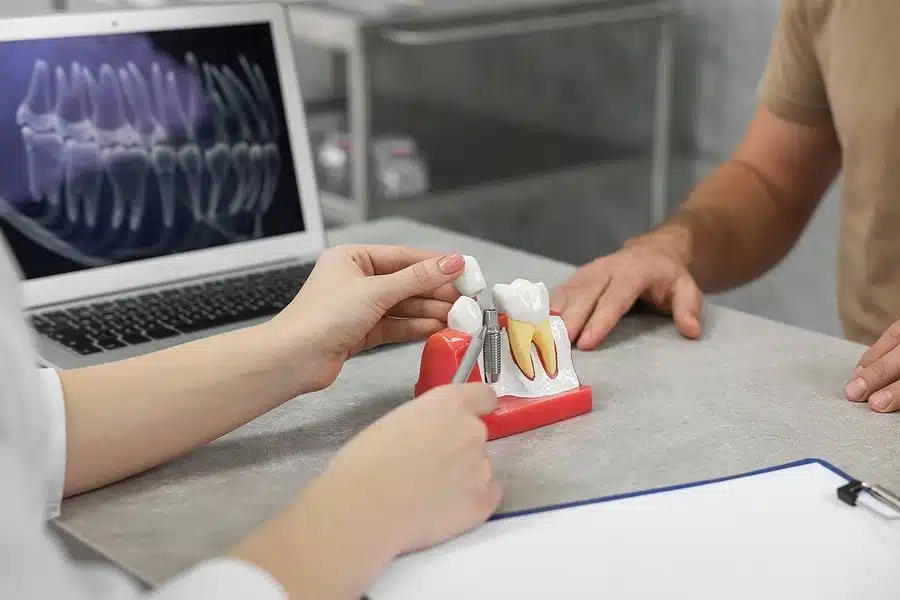
When the plan is an implant or bridge, braces do the opposite job: they open or hold the space to the exact width the replacement needs, upright the tilted neighbors so the implant can be placed straight, level the bite, and often intrude the tooth that has over-erupted into the gap from the other arch. During treatment, the space is kept with a coil spring on the wire, and a false tooth can be attached to the braces so the gap does not show. At the end, a retainer with a tooth in it holds the space until the implant is placed. The Cleveland Clinic explains how implants are placed, and the ADA covers bridges as the fixed alternative. Dr. Chung coordinates timing with the patient’s dentist or surgeon, and for a teenager, the plan usually holds the space for several years until growth is complete.
Living with the plan
Whichever route is chosen, the patient’s job is the same as in any braces case: keep the brackets intact by avoiding hard and sticky food, keep the gumline clean with a soft brush and a floss threader, and keep every adjustment, because space closure and space holding both depend on the wire being changed on schedule. A gap being closed will look smaller at each visit; a gap being held will look the same, which is the point, and the false tooth on the wire keeps it invisible. Retention afterward is stricter than average. A closed space is the single most likely place for teeth to drift apart again, so a bonded wire behind the moved teeth is common, and a held space needs a retainer with a tooth in it worn every night until the implant is placed.
Can Braces Close a Gap From a Missing Tooth in Your Case?
The decision at Smile Solutions Orthodontics is made from an examination, photographs, an iTero digital scan and, where bone is a question, i-CAT 3D imaging. Dr. Chung looks at the size of the gap, the health of the neighboring teeth, whether the bite would be improved or worsened by closing the space, whether the patient has crowding elsewhere that closing the space would resolve, the patient’s age, and what the smile would look like either way. Both options are presented with a realistic timeline, and the fee is written down; the financial information page explains payment plans. Kenilworth patients are seen at the Union office at 381 Chestnut Street, a few minutes away, and the first visit page describes what to expect.
Smile Solutions Orthodontics
Smile Solutions Orthodontics provides braces, Invisalign, SureSmile, and TMJ care for children, teens, and adults from offices in Edison, Millburn, and Union, NJ. Dr. Christopher Chung earned his DDS at UCLA and completed his orthodontic residency and a master’s in oral biology at UMDNJ; Dr. Leonid Epshteyn is an AAO member orthodontist. New patients call (973) 528-7558 or use the free consultation page.
Frequently asked questions
Can braces close a gap from a missing tooth?
Yes, in many cases, by moving neighboring teeth bodily into the space. Whether closing it is the best plan depends on which tooth is missing and the bite.
Which missing teeth are easiest to close with braces?
Lower incisors and premolars, particularly when the patient also has crowding that the extra space resolves.
Can braces close the gap from a missing molar?
In adults, rarely. Moving a molar a full tooth width forward is slow and unpredictable; an implant or bridge is usually the better choice.
Can braces replace an implant for a missing front tooth?
Sometimes. The canine can be moved into a lateral incisor’s space and reshaped, but symmetry is hard to achieve, and an implant often gives a better result.
How long does it take to close a gap with braces?
Months for a small space, over a year for a full tooth width, at visits every six to eight weeks.
Can Invisalign close a gap from a missing tooth?
Small gaps, yes. Large gaps that need teeth moved root first over a distance are more predictable with braces.
What if my teeth have already tilted into the gap?
Braces straighten them first. That is needed whether the gap is then closed or kept for an implant.
Can a teenager get an implant for a missing tooth?
Not until growth is finished, usually the late teens or later. Braces close the space or hold it with a retainer until then.
Will closing a gap with braces affect my bite?
It changes it, which is why the plan sets up the bite around the closed space. Done properly, the bite is as good as or better than before.
Is there a Smile Solutions office in Kenilworth?
No. Kenilworth patients are seen at the Union office at 381 Chestnut Street, with Edison and Millburn as the other locations.
Missing a tooth and wondering whether braces can close the gap? Book a free consultation with Smile Solutions Orthodontics. Kenilworth patients use the Union office at 381 Chestnut Street. New patients, call (973) 528-7558 or request a free consultation.